ADHD Coping Strategy Worksheets: Practical Tools for Executive Function Challenges
ADHD-specific worksheets designed around how the ADHD brain actually works — leveraging novelty, interest, and external structure to bypass executive function barriers.
BACP-Registered Counsellor & Art Therapy Specialist
TL;DR — Key Takeaway
ADHD worksheets provide structured coping strategies for executive function challenges including time management, emotional regulation, task initiation, and focus. The most effective ADHD worksheets use strength-based approaches, visual planning tools, and body-doubling techniques. Consistent use of structured tools can significantly improve daily functioning for adults and teens with ADHD.
ADHD coping strategy worksheets are essential tools for managing the daily challenges of Attention Deficit Hyperactivity Disorder. Unlike traditional planners that assume neurotypical executive function, ADHD-specific worksheets are designed around how the ADHD brain actually works — leveraging novelty, interest, urgency, and external structure to bypass executive function barriers.
With ADHD diagnoses continuing to rise globally, there is growing demand for practical, evidence-based resources that go beyond medication. Worksheets that address time blindness, emotional dysregulation, task paralysis, and working memory challenges provide the external scaffolding that the ADHD brain needs.
In this guide, I will share the most effective ADHD worksheets and coping strategies that I recommend in clinical practice, designed with the unique neurodivergent experience in mind.
For a quick self-check, try our free ADHD Focus Self-Check tool. You may also find our guide to emotional regulation worksheets helpful.
What Are the Key ADHD Executive Function Challenges?
ADHD is fundamentally a disorder of executive function — the brain's management system. This affects planning, prioritisation, time awareness, emotional control, working memory, and task initiation. Effective ADHD worksheets target these specific areas rather than relying on willpower or motivation.
Research from Dr. Russell Barkley shows that ADHD creates a gap between knowing what to do and actually doing it. Worksheets serve as external executive function tools — providing structure, prompts, and visual cues that compensate for internal regulatory challenges.
Time Blindness — Difficulty sensing how much time has passed or estimating how long tasks will take
Task Paralysis — Knowing what needs to be done but being unable to start
Emotional Dysregulation — Intense emotional reactions that feel disproportionate
Working Memory Overload — Forgetting tasks, appointments, or mid-conversation points
Hyperfocus Imbalance — Intense focus on interesting tasks while struggling with mundane ones
Decision Fatigue — Becoming overwhelmed by too many choices or steps
What Are the Best ADHD Coping Strategy Worksheets?
These worksheets are designed specifically for the ADHD brain — visual, structured, and broken into manageable steps.
Brain Dump and Priority Matrix
This worksheet provides space to externalize everything in your mind onto paper, then categorize items by urgency and importance. For ADHD, the brain dump alone reduces cognitive load and the anxiety that comes from trying to remember everything internally.
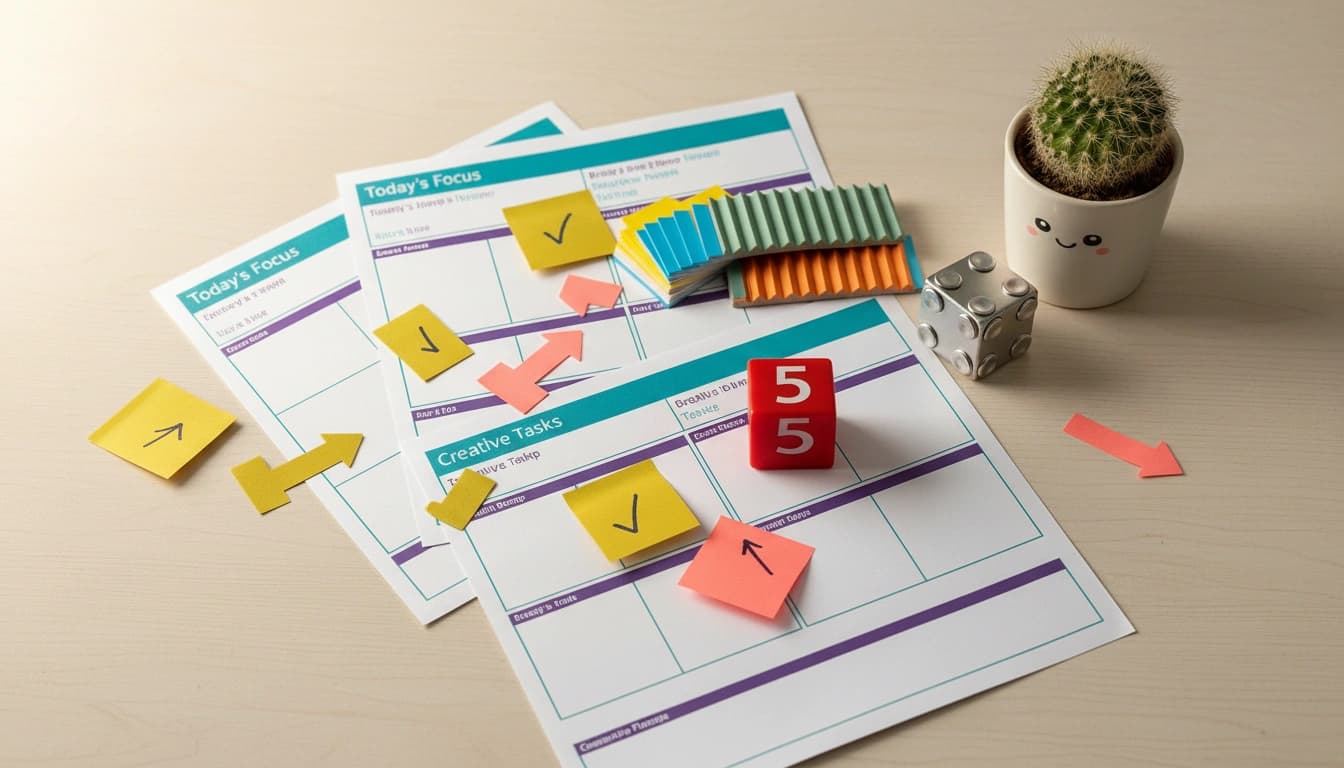
Time Block Visual Planner
Traditional to-do lists fail for ADHD because they lack time context. This visual planner assigns tasks to specific time blocks with colour coding, built-in buffer time, and transition reminders. It combats time blindness by making the day's structure visible.
Emotion Regulation Cards for ADHD
ADHD emotional dysregulation is often overlooked. These cards provide quick-reference coping strategies for common ADHD emotional patterns: rejection sensitivity, frustration intolerance, overwhelm shutdowns, and the shame spiral.
Task Initiation Prompt Cards
When you know what to do but cannot start, these cards provide physical starting prompts: set a 5-minute timer, use the two-minute rule, pair the task with something enjoyable, or use body doubling techniques.
Mindful Breathing Cards for Focus
Short, targeted breathing exercises designed to activate the prefrontal cortex and improve attention. These cards include 60-second techniques that can be used before starting difficult tasks.
ADHD-Friendly Worksheets Designed for Real Brains
Our ADHD Bundle includes strength-based coping strategies, visual planners, and emotion regulation cards — designed for how the ADHD brain actually works.
What Is the Strength-Based Approach to ADHD?
Effective ADHD worksheets do not just manage deficits — they leverage ADHD strengths. The ADHD brain excels at creative thinking, pattern recognition, crisis management, and enthusiastic pursuit of interests. Strength-based worksheets help individuals identify and build on these natural abilities while developing structured support for challenging areas.
I design all my ADHD resources with this philosophy: celebrate the strengths, support the struggles, and never frame ADHD as simply a deficit to be fixed.
“The ADHD brain does not lack ability — it lacks consistent access to ability. The right worksheets serve as bridges, providing external structure during moments when internal executive function is offline.”
Clara Ellington
BACP-Registered Counsellor & Art Therapy Specialist
Frequently Asked Questions
Ready to Start Your Journey?
Browse our complete collection of professionally designed therapeutic worksheets — crafted with clinical expertise and calming aesthetics.
Related Therapeutic Bundles
ADHD Bundle
ADHD-specific coping strategies, time management tools, and emotional regulation cards.
Emotional Regulation Kit
Comprehensive emotion regulation worksheets for neurodivergent and neurotypical individuals.
Teen Bundle
Age-appropriate resources for teens including ADHD support tools.
Found this helpful?
Share it with someone who might need it.
Written by Clara Ellington
BACP-Registered Counsellor & Art Therapy Specialist
Clara Ellington is a BACP-registered counsellor (Member No. 123456) with over 8 years of clinical experience across diverse settings. She holds a Diploma in Integrative Counselling & Psychotherapy and a Certificate in Art Therapy Facilitation, combining evidence-based therapeutic techniques with art therapy principles to create beautiful, effective mental health resources through Calm With Clara.