CBT Worksheets: The Complete Guide to Cognitive Behavioural Therapy Tools
CBT is the most researched form of psychotherapy worldwide. This guide covers the essential worksheets that make CBT principles practical and accessible.
BACP-Registered Counsellor & Art Therapy Specialist
TL;DR — Key Takeaway
CBT worksheets are the most widely researched therapeutic tools, teaching systematic approaches to identifying and changing unhelpful thinking patterns. Core tools include thought records, behavioural experiments, cognitive distortion identification, and activity scheduling. CBT is the gold standard treatment for anxiety, depression, OCD, and PTSD.
CBT worksheets form the backbone of the world's most researched and widely practised form of psychotherapy. Cognitive Behavioural Therapy works on a simple but powerful principle: the way we think affects how we feel, and how we feel affects what we do.
As a counsellor, CBT worksheets are among the tools I recommend most frequently. They provide a clear, structured framework for understanding the connection between thoughts, emotions, and behaviours — and for making meaningful changes in all three areas.
For a quick self-check, try our free Anxiety Self-Assessment tool. You may also find our guide to DBT skills worksheets helpful.
How CBT Works — The Cognitive Model
CBT is based on the cognitive model: situations trigger automatic thoughts, which influence emotions and behaviours. Unhelpful thinking patterns (cognitive distortions) can distort this process, leading to disproportionate emotional and behavioural responses. CBT worksheets help you identify and correct these distortions.
All-or-Nothing Thinking — Seeing things in black-and-white with no middle ground
Catastrophising — Assuming the worst possible outcome will happen
Mind Reading — Believing you know what others are thinking (usually negatively)
Emotional Reasoning — Assuming feelings reflect reality (I feel stupid, therefore I am stupid)
Should Statements — Rigid rules about how things should be that create guilt and frustration
Discounting the Positive — Dismissing positive experiences as not counting or being a fluke
What Are the Essential CBT Worksheets?
These are the foundational CBT worksheets used in clinical practice worldwide.
Five-Part Model Worksheet — Map the connections between situations, thoughts, emotions, physical sensations, and behaviours
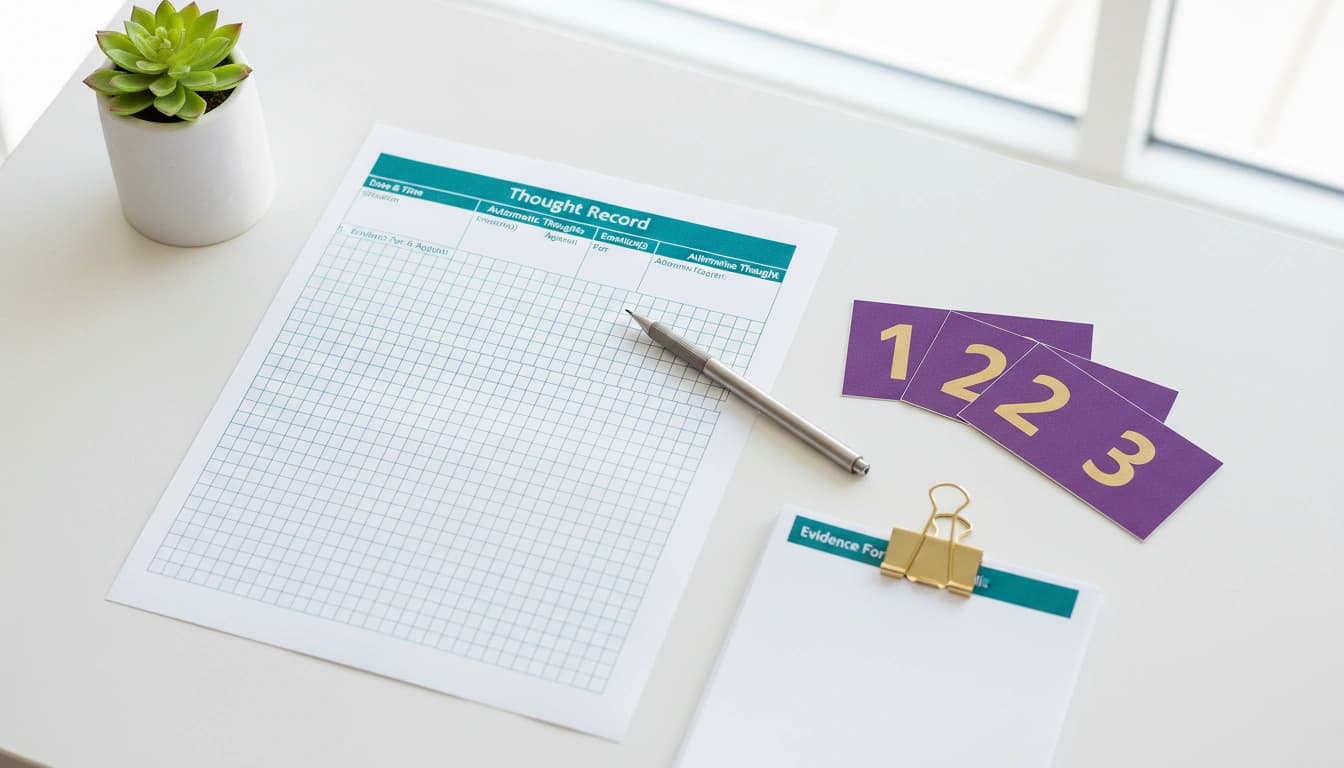
Thought Record (7-Column) — The comprehensive version including evidence evaluation and alternative thoughts
Cognitive Distortion Identification — Learn to spot the 15 most common thinking errors
Behavioural Experiment Planner — Test beliefs through real-world experiments rather than just challenging them cognitively
Activity Schedule — Plan and track activities to combat withdrawal and low mood
Core Beliefs Questionnaire — Identify deep-seated beliefs that drive surface-level thought patterns
Get Evidence-Based CBT Worksheets
Our therapeutic bundles include CBT thought records, cognitive distortion guides, and behavioural activation tools.
“CBT worksheets empower clients to become their own therapists. The skills learned through structured practice continue working long after therapy ends — that is the beauty of CBT.”
Clara Ellington
BACP-Registered Counsellor & Art Therapy Specialist
Frequently Asked Questions
Ready to Start Your Journey?
Browse our complete collection of professionally designed therapeutic worksheets — crafted with clinical expertise and calming aesthetics.
Related Therapeutic Bundles
Anxiety Management Bundle
CBT-based anxiety worksheets including thought records and coping tools.
Depression Bundle
CBT behavioural activation and cognitive restructuring for depression.
A4 Therapeutic Resources
Complete collection including core CBT worksheets across all conditions.
Found this helpful?
Share it with someone who might need it.
Written by Clara Ellington
BACP-Registered Counsellor & Art Therapy Specialist
Clara Ellington is a BACP-registered counsellor (Member No. 123456) with over 8 years of clinical experience across diverse settings. She holds a Diploma in Integrative Counselling & Psychotherapy and a Certificate in Art Therapy Facilitation, combining evidence-based therapeutic techniques with art therapy principles to create beautiful, effective mental health resources through Calm With Clara.